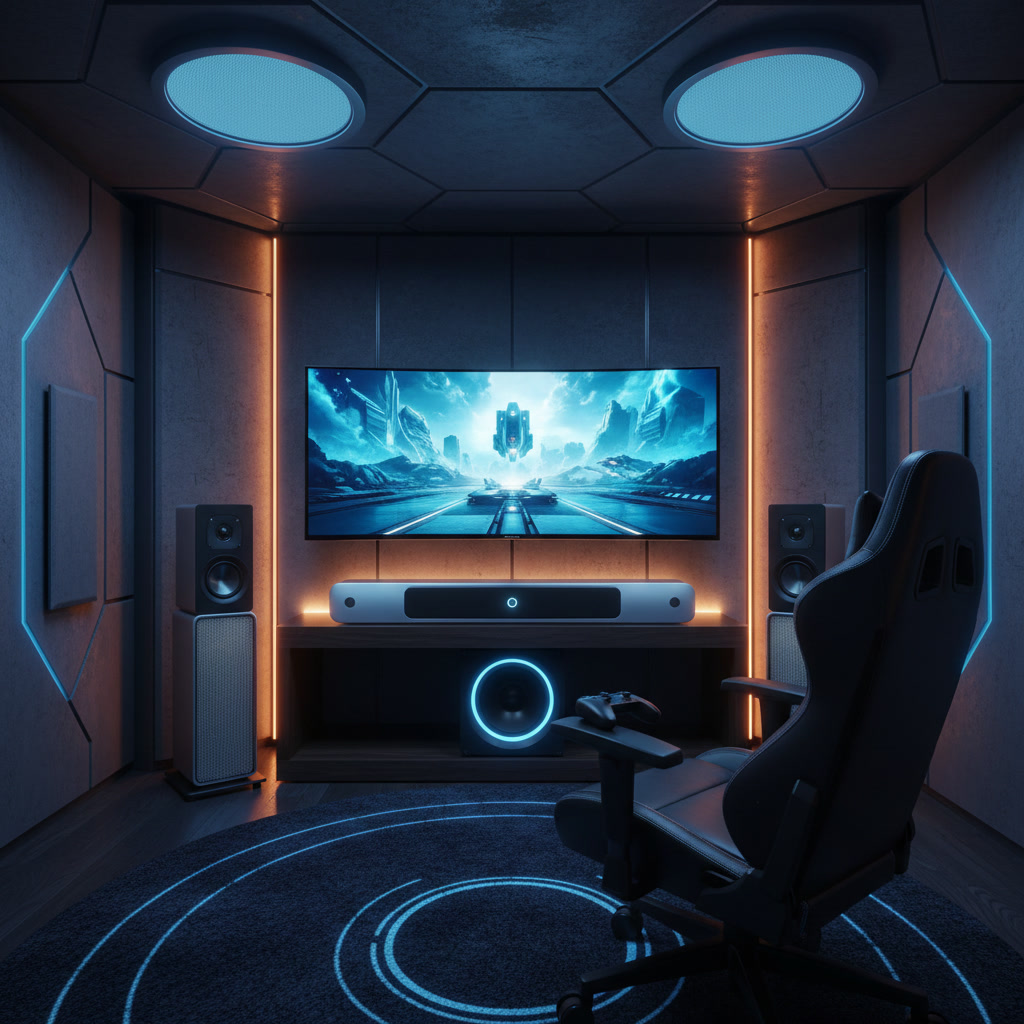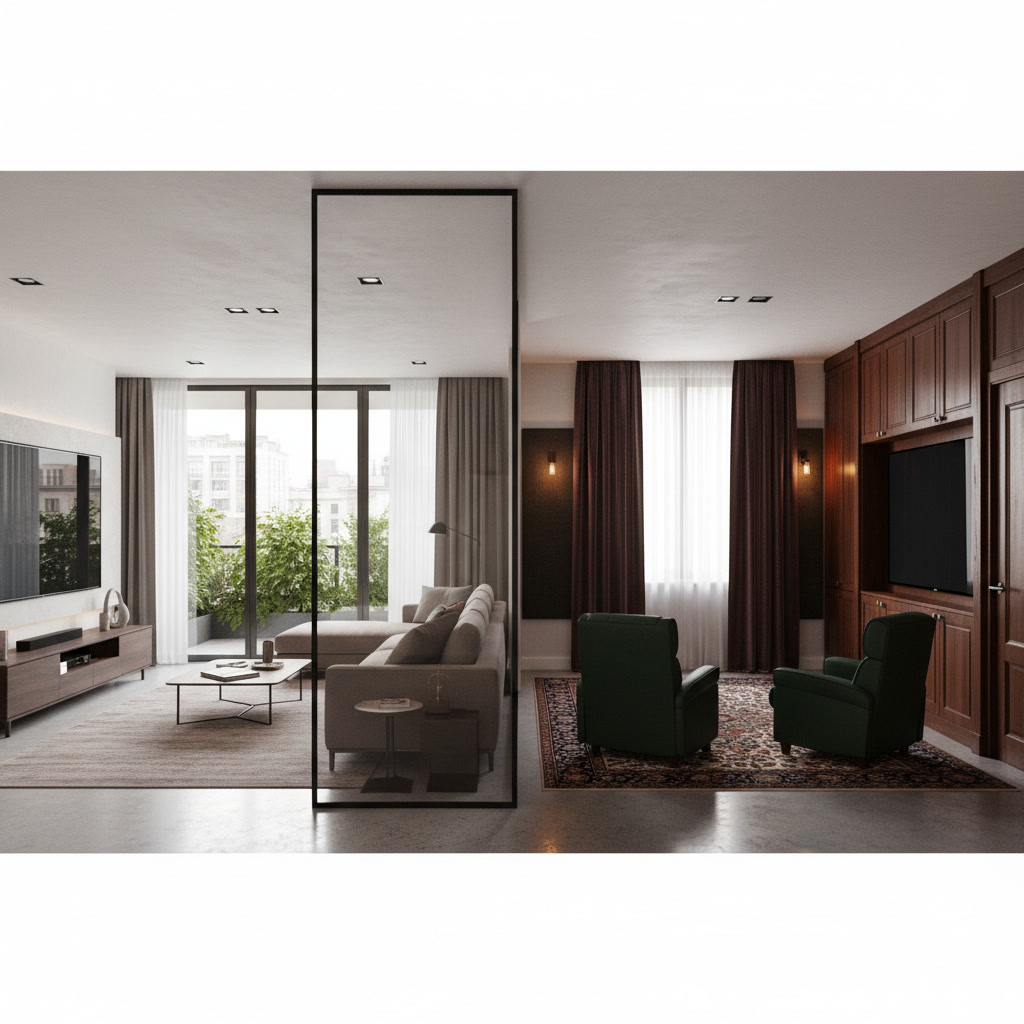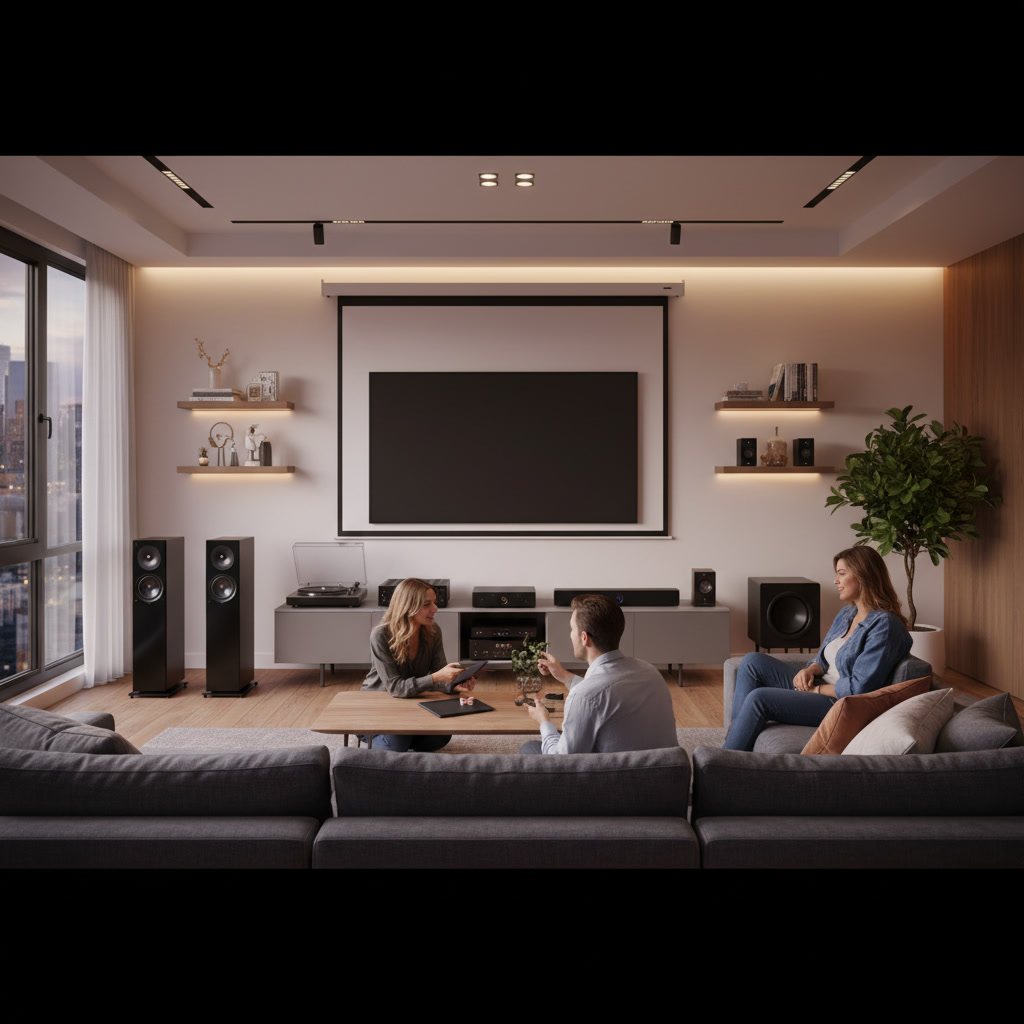
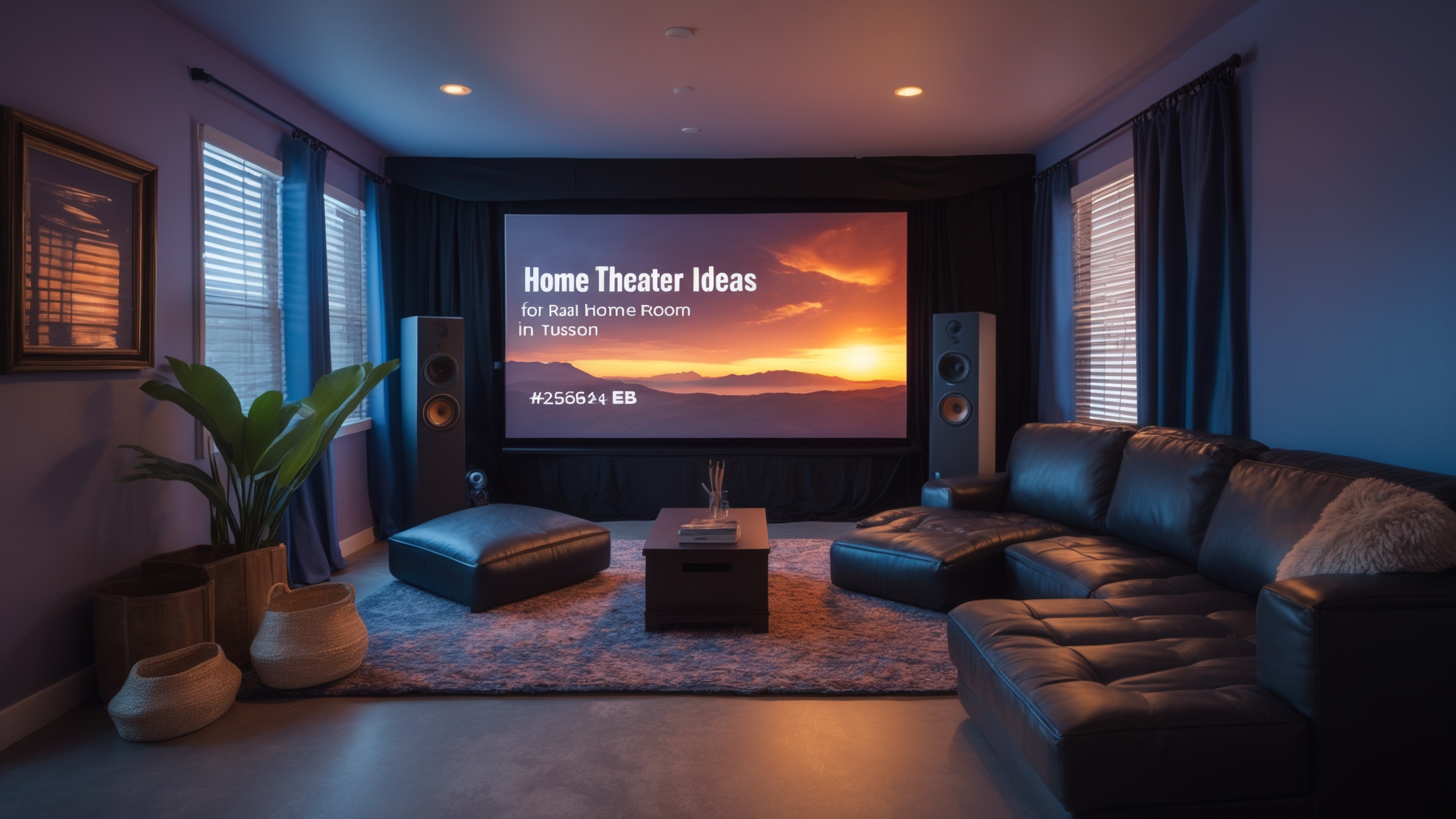
Your Scottsdale basement or bonus room sits empty or underused, holding the potential to become something far more valuable. These spaces offer the square footage, isolation, and flexibility that make exceptional home theaters possible. Smart home theater ideas can turn that unused area into the entertainment centerpiece your family and friends will want to experience every weekend.
This guide walks through practical design choices, equipment recommendations, and layout strategies specific to basement and bonus room theaters in Scottsdale homes. You will learn how to maximize your space, control light and sound, and select components that deliver cinema-quality performance without overspending.
Why Basements and Bonus Rooms Make Ideal Home Theaters
Basements and bonus rooms solve the two biggest challenges in home theater design: light control and sound isolation. Unlike living rooms with multiple windows and open floor plans, these spaces typically have fewer light sources and natural separation from the rest of the house.
The concrete walls in many Scottsdale basements provide excellent sound dampening. Your movie explosions and surround sound won’t disturb bedrooms or adjacent living spaces. Bonus rooms above garages offer similar benefits with added distance from main living areas.
These spaces also give you freedom to customize without disrupting your home’s primary flow. You can install tiered seating, blackout treatments, acoustic panels, and specialized lighting without affecting daily household traffic patterns.
Most Scottsdale homes with basements allocate between 200 and 400 square feet for entertainment areas. This provides enough room for proper screen size, speaker placement, and comfortable seating distances that smaller rooms cannot accommodate.
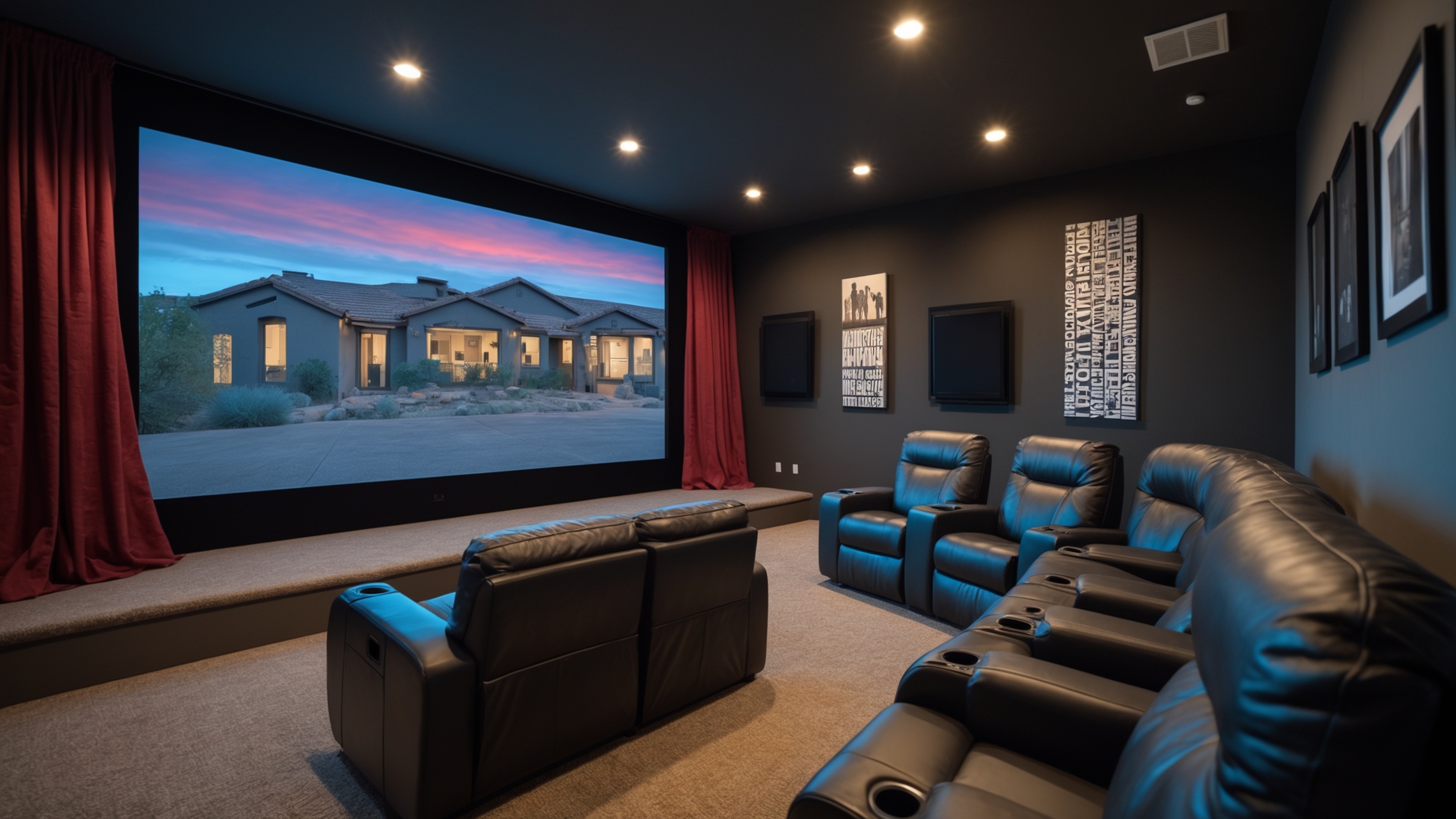
Planning Your Theater Layout and Dimensions
Screen size and viewing distance determine everything else in your theater layout. The Society of Motion Picture and Television Engineers recommends sitting at a distance 1.5 to 2.5 times your screen width for optimal viewing.
For a 120-inch diagonal screen (105 inches wide), your front row should sit 13 to 22 feet from the screen. A 100-inch screen works well in rooms where seating starts around 10 to 15 feet back. Measure your available space before selecting equipment.
Seating Arrangements That Work
Single-row seating works in rooms up to 14 feet deep. Place recliners or a sectional 10 to 12 feet from your screen, leaving walkway space behind.
Two-row configurations require at least 18 feet of depth. Elevate the second row 6 to 12 inches higher than the front to prevent sightline obstructions. Stadium seating platforms cost $800 to $2,000 installed but dramatically improve viewing comfort.
Allow 30 inches of width per seat and 42 inches of depth for reclining theater chairs. A three-seat front row and four-seat raised back row fits comfortably in a 14-foot-wide room.
Equipment Placement Considerations
Mount projectors 12 to 20 feet from your screen, depending on the throw ratio. Short-throw projectors reduce this distance but cost more. Calculate exact placement using your projector model’s specification sheet.
Audio receivers, gaming consoles, and streaming devices need ventilated cabinet space or a dedicated equipment rack. Keep this within 25 feet of your screen to avoid signal degradation with standard HDMI cables.
Subwoofers perform best in corners or along the front wall. Avoid placing them against the same wall as your seating, which creates uneven bass response.
Managing Light Control in Your Theater Space
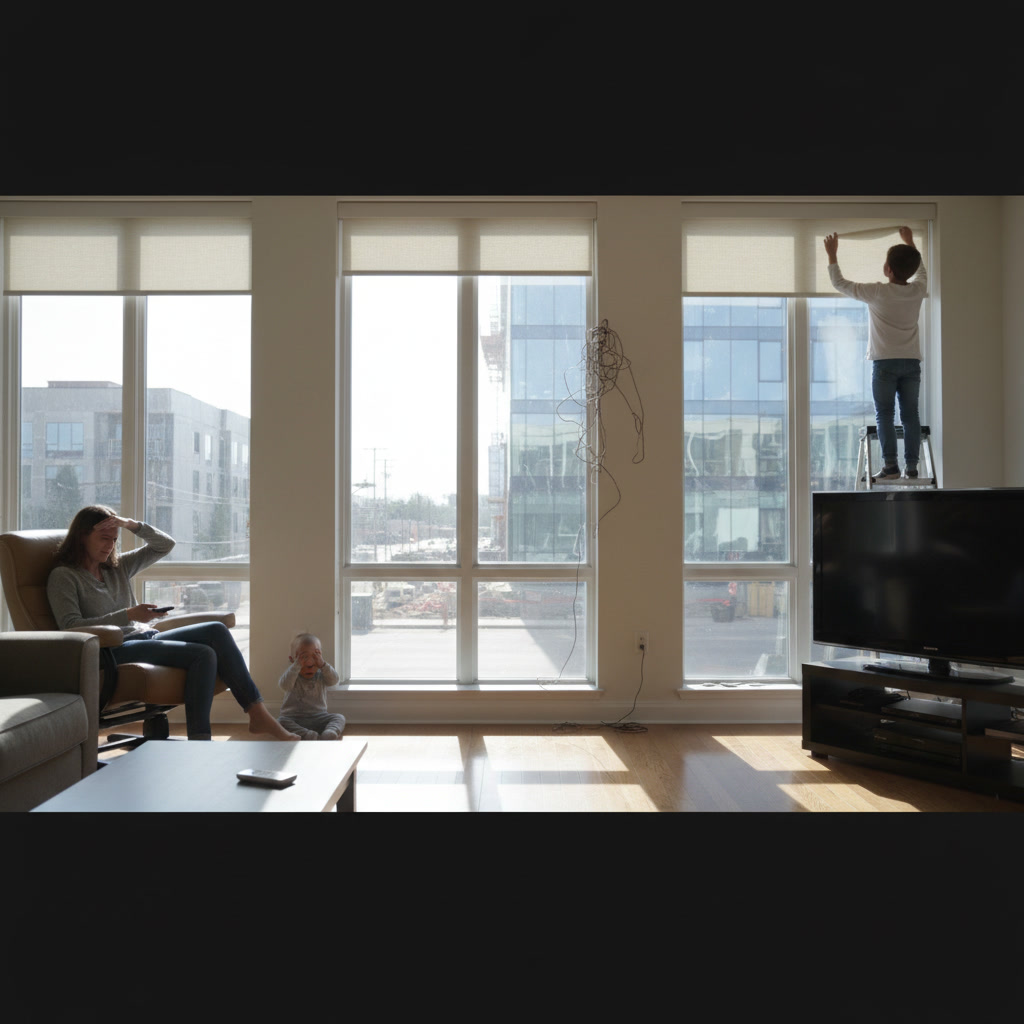
Ambient light reduces contrast and washes out picture quality. Basements with small egress windows are easier to darken than bonus rooms with multiple standard windows.
Blackout cellular shades block 99% of incoming light and provide insulation benefits in Scottsdale’s climate. Motorized versions integrate with smart home systems, allowing you to control shades without leaving your seat.
Layer blackout roller shades with curtains for complete light elimination. Budget $300 to $800 per window for quality motorized blackout treatments, or $100 to $250 for manual options.
Paint walls and ceilings in dark, matte colors. Light gray, charcoal, or black reduce screen reflections better than white or beige. Theatrical black paint on the wall behind your screen eliminates light bounce that reduces perceived contrast.
Install dimmable LED lights on separate circuits from overhead fixtures. Smart lighting systems let you program scenes for movie watching, intermission, and cleaning.
Sound System Configuration and Acoustic Treatment
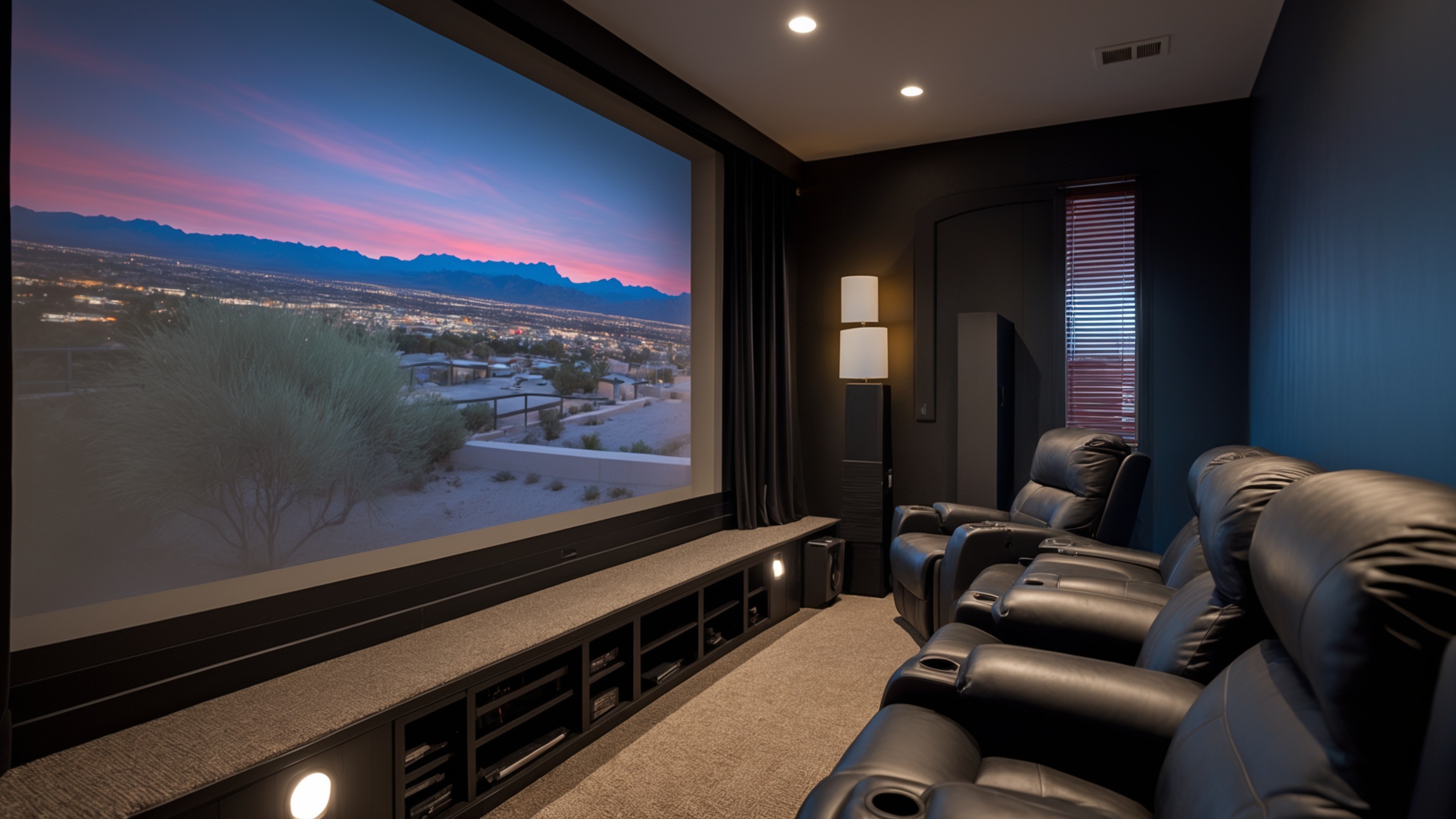
Audio quality matters as much as picture quality. A 5.1 surround system (five speakers plus one subwoofer) provides the minimum for true theater experience. A 7.1 or 7.2 configuration adds rear surround channels that improve immersion.
Place front left, center, and right speakers at ear level when seated. Angle them toward your primary seating position. The center channel handles most dialogue and should align precisely with your screen center.
Surround speakers mount 2 to 3 feet above seated ear level, slightly behind or to the sides of your seating area. Rear surrounds in a 7.1 system mount directly behind the seating position.
Acoustic Panels and Bass Traps
Hard surfaces create echo and sound reflections that muddy dialogue and reduce clarity. Acoustic panels absorb mid and high frequencies, while bass traps handle low-frequency buildup in corners.
Install panels at first reflection points: the spots on side walls and ceiling where sound bounces between speakers and listeners. Six to eight 2-foot-by-4-foot panels typically suffice for rooms under 300 square feet.
Bass traps in all four corners prevent the boomy, uneven low frequencies common in rectangular rooms. This treatment costs $400 to $1,200 but delivers immediately noticeable improvements.
Thick carpet with quality padding absorbs sound better than tile or concrete. If your basement has concrete floors, add area rugs under and around seating areas.
Choosing Between Projectors and Large-Format TVs
Projectors deliver screen sizes from 100 to 150 inches, creating true cinema scale impossible with TVs. Quality 4K projectors start around $1,500, with excellent options available between $2,500 and $5,000.
Projectors require controlled light environments. Even with high-lumen models, ambient light reduces picture quality. They also need regular bulb or laser module maintenance.
Large-format TVs between 75 and 98 inches work well in smaller bonus rooms or spaces with light control challenges. Modern OLED and QLED displays produce exceptional picture quality with deep blacks and vibrant colors.
TVs require no maintenance beyond cleaning and handle ambient light better than projectors. The tradeoff is maximum screen size. Even 98-inch models feel smaller than 120-inch projection screens.
For dedicated basement theaters where you control all light, projectors offer better value per screen inch. For bonus rooms used during daytime or multipurpose spaces, large TVs provide more flexibility.
Smart Home Integration and Control Systems
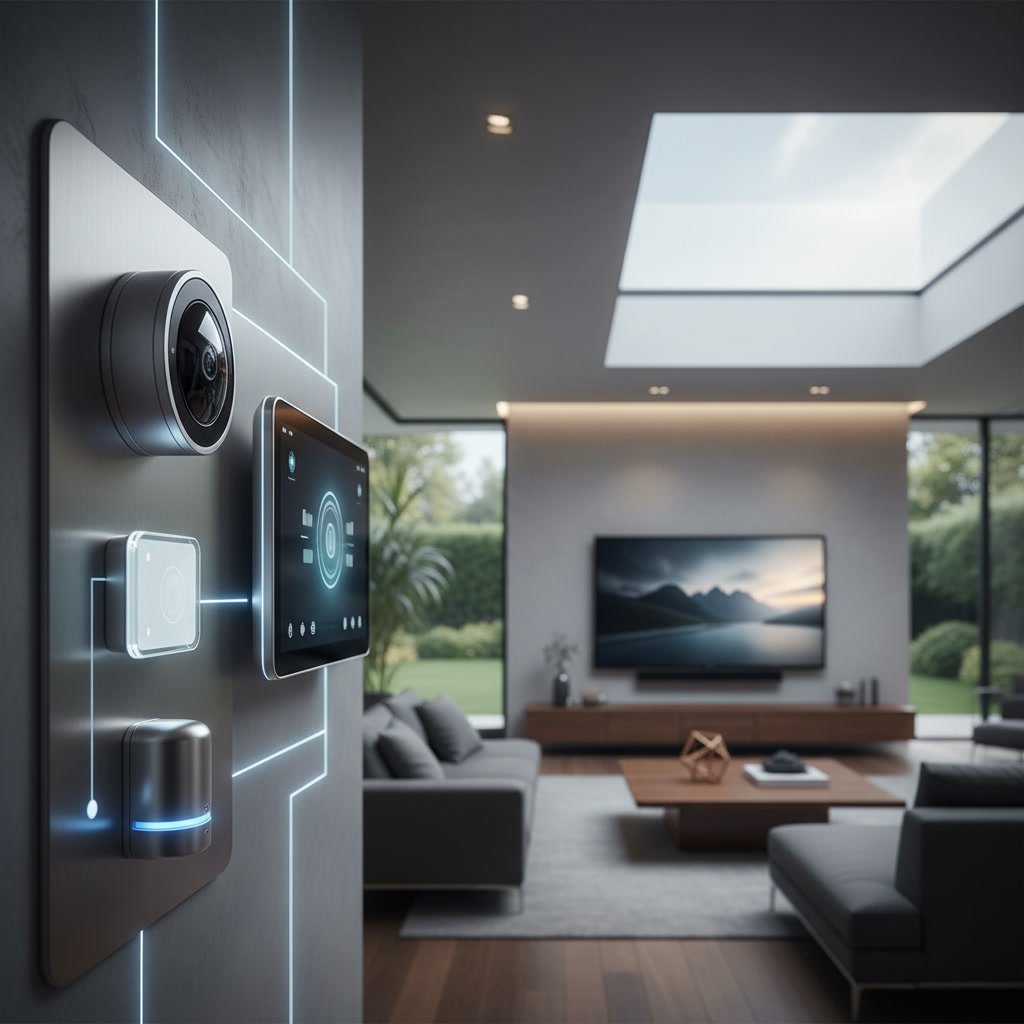
Modern home theater ideas incorporate automation that simplifies operation. Universal remotes or smartphone apps control your projector, receiver, streaming devices, lights, and shades from a single interface.
Control systems from Savant, Control4, or Crestron provide professional-grade integration. These systems cost $3,000 to $10,000 installed but deliver seamless operation and custom programming.
Budget-friendly options include Logitech Harmony remotes ($250 to $350) or smart home platforms like Google Home and Amazon Alexa. These handle basic functions but lack the customization of dedicated control systems.
Automated scenes activate multiple devices simultaneously. A “Movie Night” scene dims lights, lowers shades, powers on your projector and receiver, and selects your preferred input with one command.
Network connectivity matters for streaming. Basement locations often suffer from weak wifi signals. Wired ethernet connections or mesh network systems ensure reliable 4K streaming without buffering.
Gaming Integration
Gaming rooms share many requirements with home theaters but need low-latency displays. Projectors introduce 30 to 50 milliseconds of input lag, noticeable in fast-paced games.
Look for gaming-mode projectors with lag under 20ms or use a large TV for competitive gaming. Many theater owners maintain both options, switching between projector for movies and TV for gaming.
Climate Control and Ventilation for Scottsdale Theaters
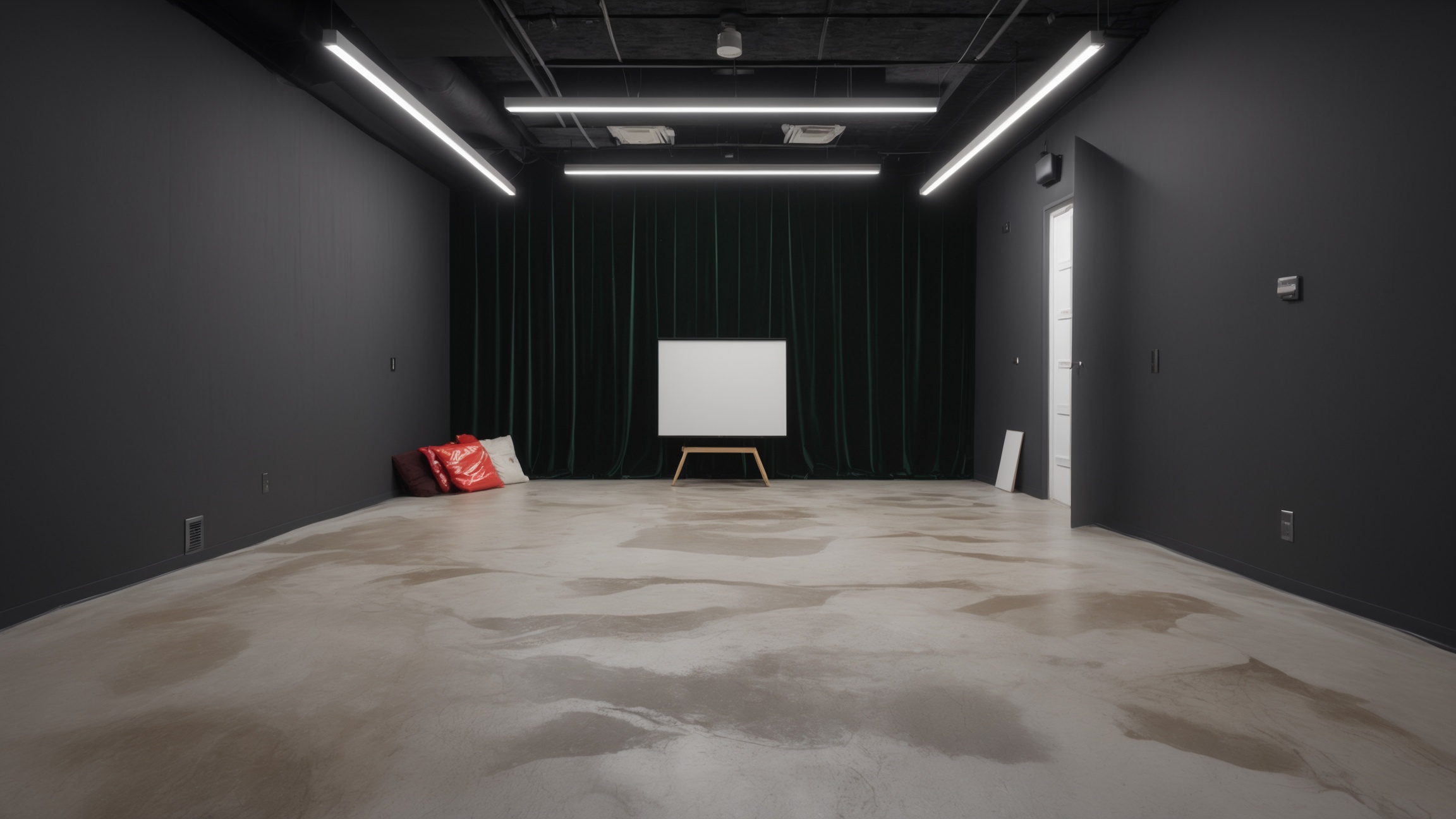
Electronics generate heat. Projectors, receivers, and amplifiers need proper ventilation to prevent overheating and extend equipment life.
Dedicated HVAC zones let you cool your theater independently from the rest of your home. This prevents wasting energy cooling unused basement space while allowing comfortable temperatures during movie sessions.
If separate zoning is not possible, portable or mini-split air conditioning units provide targeted cooling. Budget $1,500 to $3,500 for a quality mini-split system that handles 200 to 400 square feet.
Equipment racks need ventilated doors or fan systems when housing multiple heat-generating components. Rack-mounted cooling fans cost $100 to $300 and prevent thermal shutdowns.
Scottsdale’s dry climate means humidity is rarely an issue, but basements can trap moisture. Run a dehumidifier if you notice condensation or musty odors that could damage electronics or fabrics.
Budget Planning for Your Theater Project
Home theater ideas scale to almost any budget. A basic setup with a quality 75-inch TV, soundbar, and streaming device costs $2,000 to $4,000. Mid-range theaters with projectors, 5.1 surround sound, and basic acoustic treatment run $8,000 to $15,000.
High-end installations with 4K laser projectors, Dolby Atmos sound, automated controls, and custom seating reach $25,000 to $60,000 or more.
Prioritize components based on impact. Spend more on your screen and audio system than on fancy seating initially. You can upgrade furniture later, but changing core equipment means starting over.
Pro Tip: Allocate 40% of your budget to audio equipment and acoustic treatment, 30% to video components, 20% to seating and furniture, and 10% to lighting and control systems. This distribution maximizes performance across all aspects of the theater experience.
Professional installation adds 20% to 40% to equipment costs but ensures proper calibration, wire management, and warranty support. Complex projects involving electrical work, HVAC modifications, or structural changes require licensed contractors.
Working with Professional Installers in Scottsdale
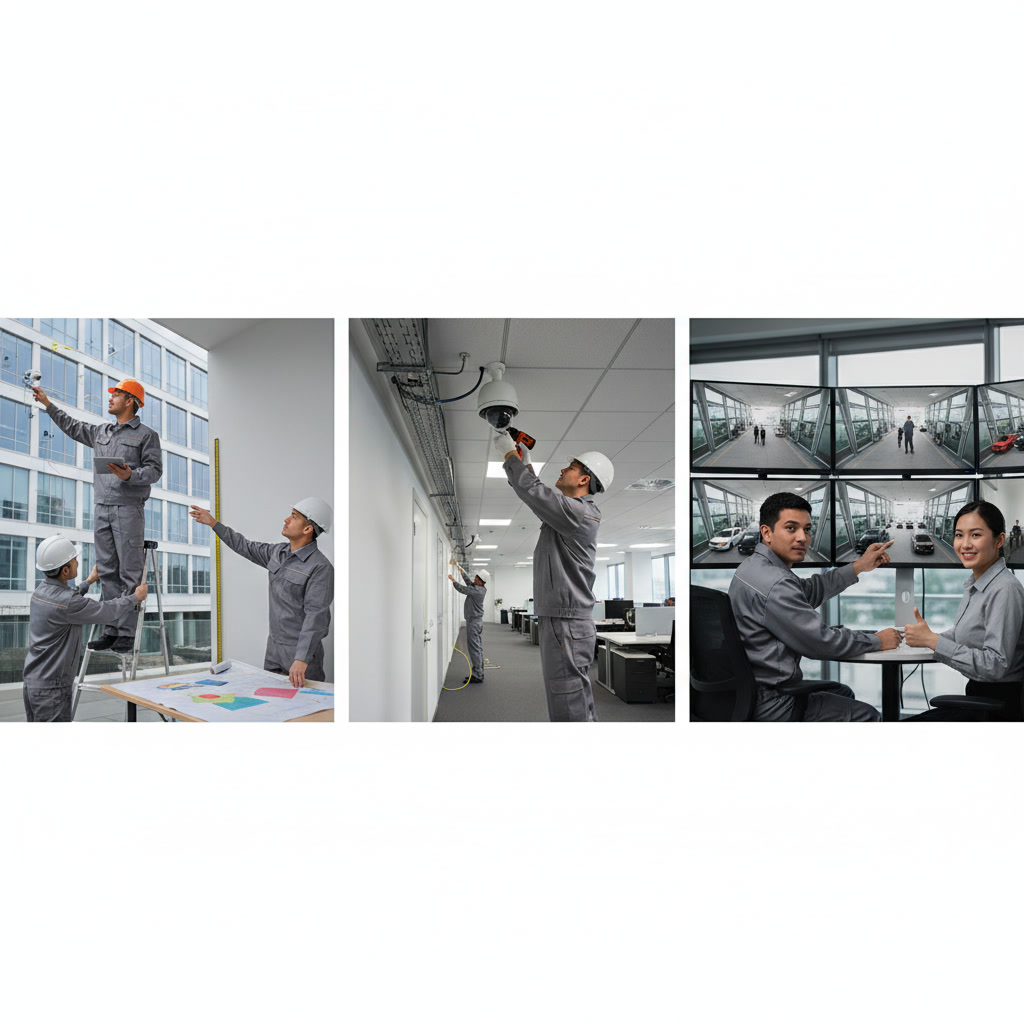
Professional audiovisual contractors bring experience that prevents costly mistakes. They understand sight lines, acoustic properties, and equipment compatibility issues that affect long-term satisfaction.
Installers handle permits for electrical work, ensure code compliance for egress windows in basements, and coordinate with other trades when projects involve construction.
Quality contractors provide detailed designs showing equipment placement, wire runs, and speaker locations before installation begins. This preview helps you visualize the finished space and request changes early.
Post-installation calibration separates adequate theaters from exceptional ones. Professional calibration of video displays and audio systems using measurement tools delivers performance you cannot achieve with consumer-grade setup wizards.
Look for contractors with manufacturer certifications from brands like Crestron, Lutron, or THX. These credentials indicate training and expertise beyond basic installation skills.
Frequently Asked Questions
What is the minimum room size needed for a home theater?
A dedicated home theater needs at least 11 feet by 13 feet (143 square feet) for a single row of seating and a modest screen. Rooms smaller than this work better as media rooms with large TVs rather than projection-based theaters. For optimal two-row configurations with proper speaker placement, plan for at least 14 feet by 18 feet (252 square feet).
How much does a basement home theater cost in Scottsdale?
Basic basement theater setups start around $5,000 for equipment and simple installation. Mid-range projects with quality projectors, surround sound, acoustic treatment, and professional installation typically cost $12,000 to $25,000. Custom theaters with premium components, tiered seating, and complete automation range from $30,000 to $75,000 or more depending on room size and finishes.
Should I choose a projector or large TV for my bonus room theater?
Choose a projector if your bonus room has excellent light control and you want screen sizes above 100 inches. Large-format TVs work better in rooms with windows you use during daytime, multipurpose spaces, or rooms where you cannot achieve complete darkness. TVs also eliminate projector maintenance and perform better for gaming due to lower input lag.
Do I need acoustic panels in a carpeted basement theater?
Yes, carpet alone does not provide sufficient acoustic treatment. Carpet absorbs some high frequencies but does little for mid-range frequencies or bass buildup. Proper acoustic panels on walls and bass traps in corners dramatically improve dialogue clarity and overall sound quality even in carpeted rooms. Plan for at least six to eight panels plus corner bass traps for rooms under 300 square feet.
Can I install a home theater myself or should I hire professionals?
Capable DIYers can handle basic theater installations with consumer-grade equipment, especially in straightforward rooms with simple layouts. Hire professionals for projects requiring in-wall wiring, complex automation systems, acoustic design, or when installing premium equipment where improper setup wastes the investment. Professional calibration services alone, even after self-installation, significantly improve performance and cost $300 to $800.
Creating Your Scottsdale Home Theater
The right home theater ideas transform unused basement and bonus room space into entertainment destinations that increase your home’s value and your family’s enjoyment. Focus on fundamentals like proper viewing distances, quality audio components, effective light control, and acoustic treatment before spending on luxury extras.
Professional design and installation ensure your theater performs as intended from day one. Pro Home Entertainment LLC serves Scottsdale and surrounding areas including Phoenix, Mesa, Cave Creek, and Fountain Hills with complete home theater design and installation services. Our team handles everything from equipment selection and acoustic planning to network integration and final calibration.
Contact Pro Home Entertainment at +12068194038 to discuss your basement or bonus room theater project. We provide detailed consultations, custom designs, and professional installation that brings your entertainment vision to reality.