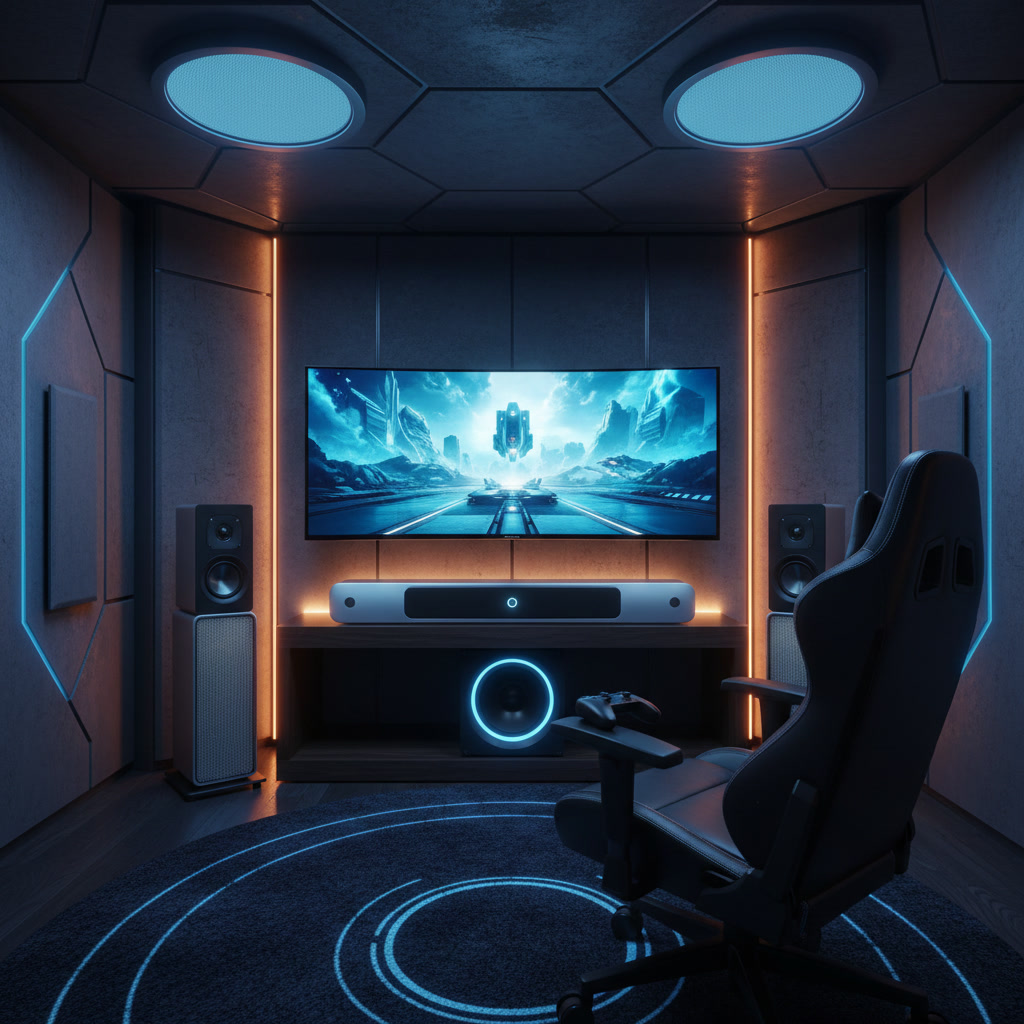
The right gaming room speaker setup determines whether you hear footsteps behind you before it’s too late or miss crucial audio cues entirely. Soundbars offer simple placement and decent spatial effects, while in-ceiling speakers create true overhead surround sound with cleaner aesthetics. Both approaches deliver immersive gaming audio, but they differ significantly in installation complexity, room coverage, and how well they handle directional sound effects in fast-paced games.
Why Audio Placement Matters More Than Speaker Quality in Gaming
Many gamers invest heavily in high-end speakers but place them poorly, wasting their potential. A mid-range speaker in the correct position outperforms a premium model stuck in the wrong spot. Positional audio in modern games relies on precise speaker angles and distances to simulate real-world sound propagation. When an explosion happens to your left or enemy dialogue comes from above, your brain calculates direction based on timing differences measured in milliseconds.
Ceiling-mounted and floor-level speakers interact with your room differently. Hard surfaces like drywall and glass reflect sound waves, while furniture and carpets absorb them. The path sound travels from speaker to ear changes its character. A soundbar firing horizontally bounces off walls to create virtual height, while in-ceiling speakers send audio straight down, reducing unwanted reflections.
How Soundbars Create Immersive Audio Without Multiple Speakers
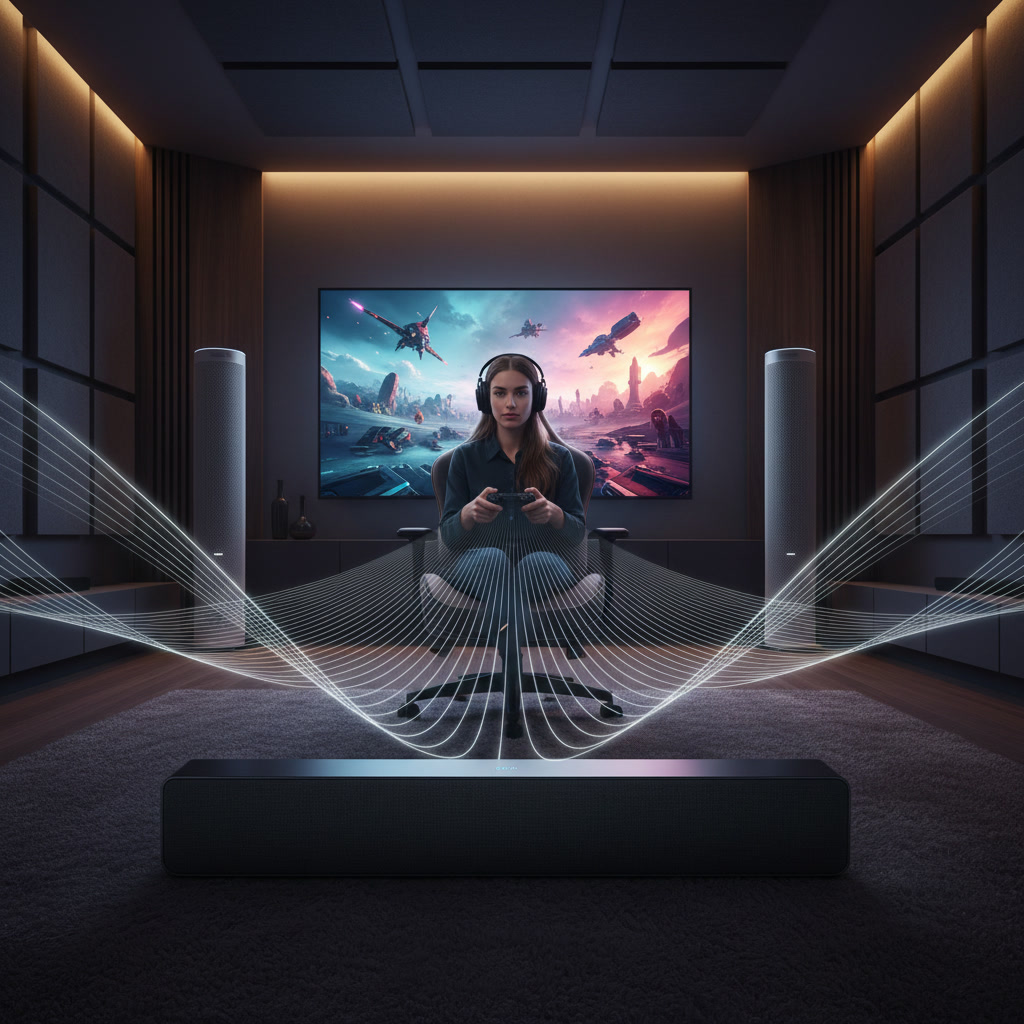
Modern soundbars use psychoacoustic tricks to simulate surround sound from a single cabinet. Angled drivers fire at side walls, creating reflected sound that appears to come from beside or behind you. Digital signal processing adjusts timing and frequency to fool your brain into perceiving height channels. Some premium models add upfiring drivers that bounce audio off your ceiling to simulate overhead effects like helicopters or rain.
The effectiveness depends entirely on your room geometry. Rectangular rooms with flat ceilings and solid side walls work best. Open-concept spaces, vaulted ceilings, or rooms with heavy acoustic treatment destroy the reflections soundbars need. If your gaming room has large openings to adjacent areas or angled architecture, soundbar virtualization struggles to maintain convincing directionality.
The Real Performance Difference Between Soundbar and Discrete Ceiling Speakers
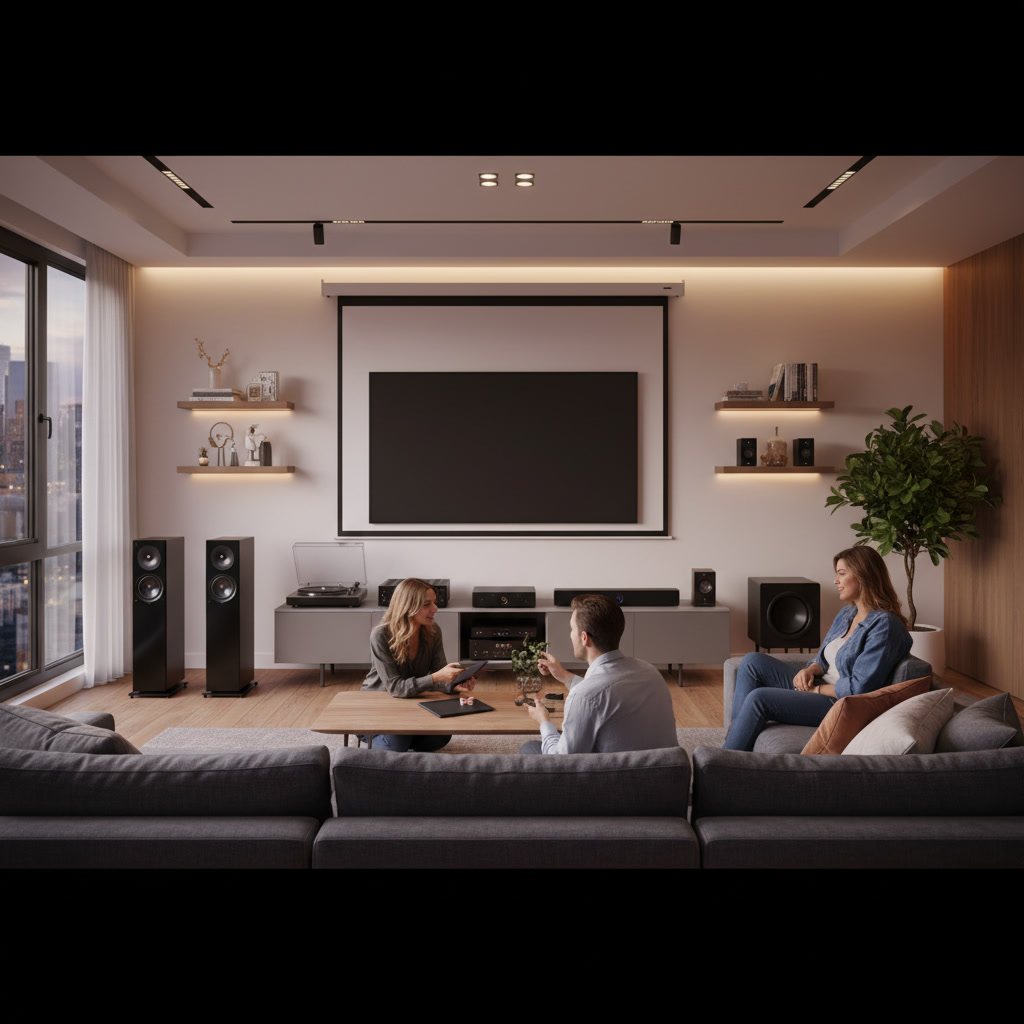
Discrete speakers physically positioned around your space produce actual surround sound, not simulated versions. In-ceiling speakers placed at front-left, front-right, and rear positions create genuine 360-degree coverage. When a game engine sends audio to the rear-right channel, that sound actually comes from behind and to your right. No psychoacoustic processing required.
Soundbars excel at frontal imaging. Dialogue clarity, center-channel effects, and left-right separation often match or exceed entry-level discrete systems. But vertical height and rear presence lag behind. You’ll hear things happening around you, but pinpointing whether that gunfire is directly behind or 30 degrees to the right becomes harder. Competitive gamers who need split-second directional accuracy notice this limitation immediately.
Installation Complexity and What It Means for Your Mesa Gaming Space
Soundbar installation takes minutes. Mount the bar below your display, plug in power and HDMI, pair the wireless subwoofer, and you’re done. No wire fishing, no ceiling cuts, no amplifier configuration. This simplicity makes soundbars ideal for renters or anyone avoiding permanent modifications.
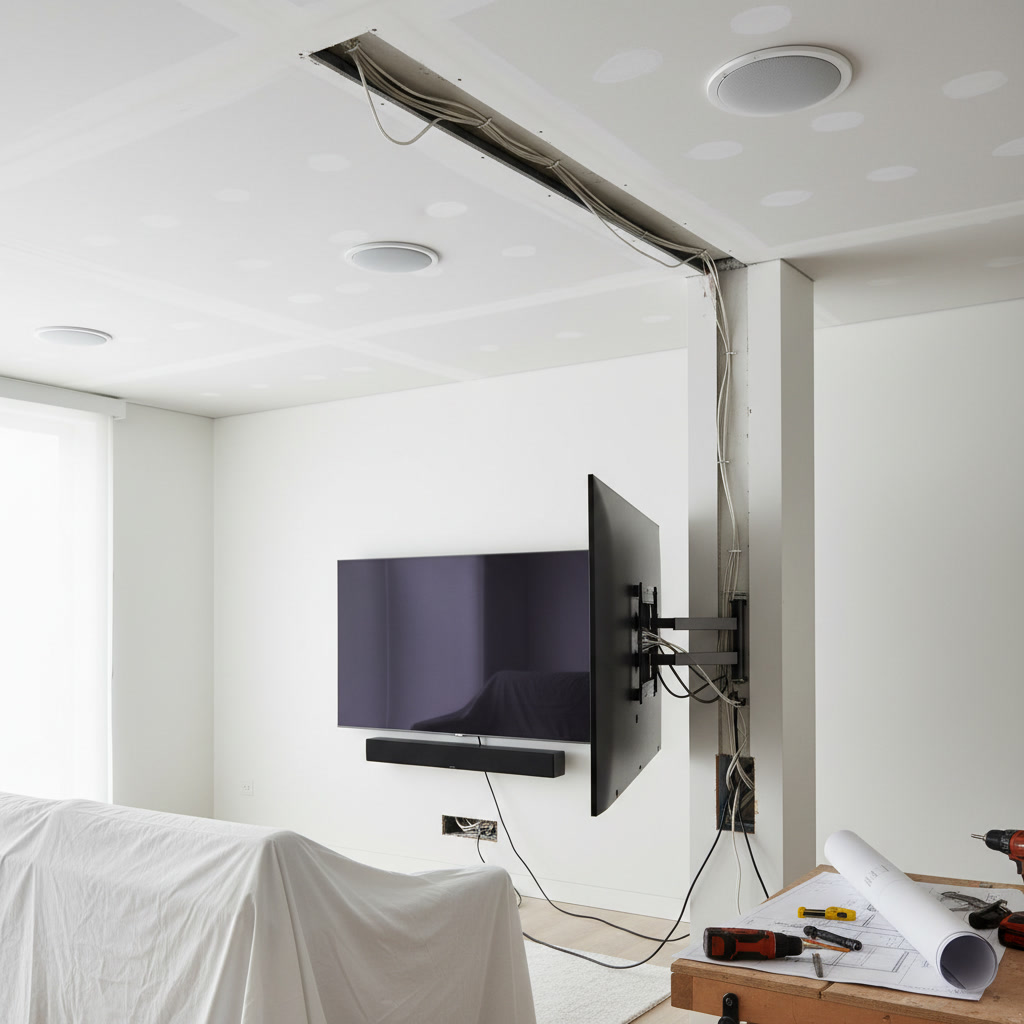
In-ceiling speakers require professional installation in most cases. Installers cut precise holes, run speaker wire through attic spaces or conduit, mount brackets, and wire everything to an AV receiver. The process takes hours and leaves permanent ceiling openings. Pro Home Entertainment LLC handles these installations throughout Mesa and surrounding areas, ensuring clean wire runs and proper speaker placement that accounts for joist locations and insulation.
The trade-off is permanence versus performance. Soundbars move with you when you relocate. Ceiling speakers become part of the room. If you own your home and plan to stay, ceiling speakers add value. If you might move within a few years, soundbars preserve flexibility.
Comparing Five Key Performance Factors Side by Side
Directional accuracy: In-ceiling speakers win decisively. Physical positioning beats virtual processing every time for pinpointing exact sound sources.
Bass response: Soundbars typically include dedicated wireless subwoofers that deliver deeper low-frequency extension than most in-ceiling models. Ceiling speakers require a separate subwoofer added to the system.
Aesthetic impact: In-ceiling speakers nearly disappear, leaving only small grilles. Soundbars sit prominently below your display, though slim models minimize visual bulk.
Expandability: Ceiling-based systems grow easily. Add more speakers, upgrade the receiver, or integrate with whole-home audio solutions as your needs evolve. Soundbars offer limited expansion, usually just adding rear satellites.
Room correction: Both approaches benefit from calibration, but discrete systems allow individual speaker level adjustments. Soundbars apply global EQ that can’t compensate for asymmetrical room layouts as precisely.
Budget Realities and Long-Term Value Considerations
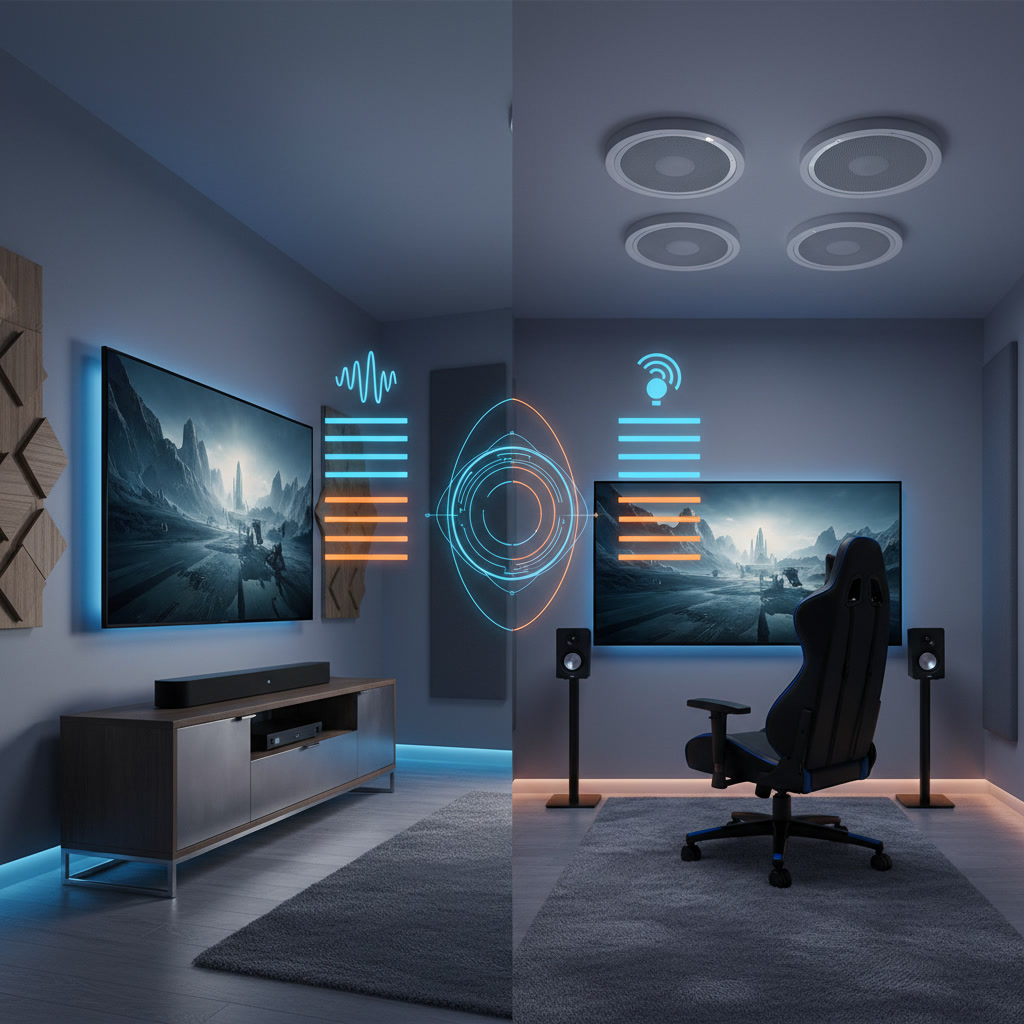
Entry-level soundbars with basic surround virtualization start around 200 dollars. Mid-range models with upfiring height channels and wireless subwoofers run 400 to 800 dollars. Premium soundbars with advanced room calibration reach 1,200 dollars or more.
In-ceiling speaker systems cost more upfront when you include installation labor. Four quality ceiling speakers run 400 to 1,000 dollars depending on brand and performance tier. Add an AV receiver for 300 to 800 dollars, a subwoofer for 300 to 600 dollars, and professional installation labor. Total system cost typically lands between 1,500 and 3,500 dollars for a properly designed setup.
The value calculation extends beyond initial cost. Soundbars become obsolete as connection standards evolve. HDMI versions change, audio codecs update, and manufacturers discontinue models. Discrete component systems allow incremental upgrades. Replace the receiver to gain new features while keeping speakers. Upgrade speakers one pair at a time. Quality ceiling speakers often outlast three generations of receivers.
How Room Size and Ceiling Height Impact Your Choice
Small gaming rooms under 150 square feet favor soundbars. The close walls and ceiling provide the reflective surfaces virtual surround needs. Listeners sit near enough to the soundbar that direct sound dominates, reducing the importance of rear speakers. Setup simplicity matters more when space is tight.
Larger rooms above 250 square feet expose soundbar limitations. The distance from side walls increases, weakening reflected sound. Virtual height effects diminish as ceiling distance grows. Listeners farther from the soundbar hear more room reflections and less direct sound, muddying the stereo image.
Ceiling height matters especially for in-ceiling installations. Standard eight-foot ceilings work well. Speakers fire down at comfortable angles, and bass coupling with the ceiling boundary reinforces low frequencies. Vaulted or cathedral ceilings above 10 feet create challenges. Sound disperses over greater distances, and aiming speakers toward the listening position becomes critical. Some designs work better with angled in-ceiling models rather than standard downward-firing speakers.
Smart Home Integration and Future-Proofing Your Audio System
Both soundbars and ceiling speaker systems integrate with smart home platforms, but the implementation differs. Soundbars typically include built-in voice assistants, streaming services, and wireless connectivity. Control happens through the soundbar’s interface or companion app.
Discrete systems rely on the AV receiver for smart features. Modern receivers support voice control, multi-room audio, streaming, and automation integration. This centralized approach makes sense if you’re building a broader home automation system. Your gaming audio becomes one zone in a whole-home setup, controlled through a unified interface.
Future audio formats matter for gaming. Dolby Atmos and DTS:X add height channels that place sounds above you. Soundbars simulate these formats through upfiring drivers and processing. Discrete systems with actual ceiling speakers reproduce height channels as the engineers intended, delivering the full effect when games support these codecs.
The Installation Detail Most Professionals Know but Homeowners Miss
Speaker wire gauge makes a bigger difference than most people realize, especially for in-ceiling installations where you can’t easily swap cables later. Many installers default to 16-gauge wire because it’s cheaper and easier to pull through tight spaces. But 14-gauge or even 12-gauge wire reduces resistance over long runs, preserving power delivery and damping factor.
The audible difference becomes obvious in larger rooms where wire runs exceed 30 feet. Bass response tightens, dynamics improve, and high frequencies retain clarity. Experienced installers calculate wire gauge based on run length and speaker impedance, not just code minimums. This attention to detail separates adequate installations from excellent ones that maintain performance for decades.
Similar insights around many aspects of professional home theater design often make the difference between a system that sounds good initially but disappoints over time versus one that continues impressing years later.
When Hybrid Approaches Make Sense for Certain Gaming Setups
Some installations benefit from combining both technologies. A soundbar handles front channels where dialogue clarity and center imaging matter most, while in-ceiling speakers provide rear and height effects. This hybrid approach costs less than a full discrete system while delivering better surround performance than a soundbar alone.
The configuration works especially well in rooms where front-wall mounting is simple but running wires to rear positions is difficult. The soundbar covers three or five front channels, and two ceiling speakers behind the listening position handle surround duties. A wireless subwoofer completes the system without additional wire runs.
Hybrid setups require receivers that support mixed speaker configurations or soundbars with discrete surround inputs. Not all models work this way, so verifying compatibility before purchasing prevents frustration during installation.
Making the Right Choice for Your Gaming Audio Priorities
Your decision comes down to what matters most in your gaming experience and your space constraints. Soundbars deliver excellent results for casual and moderate gaming in smaller rooms, especially when installation simplicity and budget are priorities. They handle movies and music well too, making them versatile entertainment solutions.
In-ceiling speakers justify their higher cost and installation complexity when accurate positional audio affects your gaming performance, when you want a clean aesthetic without visible equipment, or when you’re building a dedicated gaming space in a permanent home. The investment pays dividends through superior immersion and longevity.
Consider your current needs and likely changes. If you’re unsure whether you’ll stay in your current home or how your gaming habits might evolve, starting with a quality soundbar preserves options. If you know this room will serve as your primary gaming space for years and you value best-in-class audio, in-ceiling speakers make sense from the start.
Getting Professional Help for Your Gaming Audio Project
The difference between good audio and great audio often comes down to proper system design and installation quality. Speaker placement, wire routing, calibration, and acoustic treatment all affect the final result. DIY installations can work for simple soundbar setups, but in-ceiling systems benefit from professional expertise.
Pro Home Entertainment LLC brings years of experience designing and installing gaming audio systems throughout the Phoenix metro area. Whether you choose soundbar simplicity or discrete speaker performance, proper installation ensures you get the full capability of your equipment investment.
Ready to transform your gaming audio from basic to immersive? Contact our team at +12068194038 to discuss your space, budget, and gaming priorities. We’ll help you design a system that matches your needs and install it right the first time.